Discover our Families
Product Gallery
Product Catalogue
Our Solutions
Solutions Catalogue
Projects
Documentation
Help
Applications
Customization
This “SERVICE ONLY” screw terminal is for internal use in case of repair of the device.
The commons of different devices must not be connected together. The reason behind this point is that each device generates its own voltage of reference, so if you join different commons you can expect abnormal behaviour in those inputs and, in extreme cases, hardware damage due to the different voltage utilised by each device.
Is not necessary to bridge the commons of the same device as they are bridged internally.
Previously, a KNX line segment supported up to 64 devices, requiring line repeaters to expand up to 256 devices. The reason for these limits is to ensure the integrity of the KNX telegram as it passes through multiple devices.
The TP-256 standard now allows 256 devices on a single line without repeaters, thanks to advancements in electronics that ensure the integrity of KNX telegrams over more devices.
Zennio devices are TP-256.
There are two standards for testing the properties of conductors: IEC (mm2) and UL (AWG). Both standards have different tests, and there is no direct cross-section equivalence between them. For this reason, in our data sheets we include compatible cable cross-sections that meet the requirements of both tests.
It is true that there are no external push buttons, unlike the rest of the actuators, to operate the relays. However, there is always the option of acting directly on the outputs with the infrared remote control.
This “SERVICE ONLY” screw terminal is for internal use in case the device needs repair.
KLIC Devices:
IRSC Plus:
When to Use Each:
Yes, it is possible to integrate new IR remote controllers with IRSC Plus. First of all, please check if your model is listed in the Correspondence Table IRSC Plus. If it does not appear in the correspondence table, it only means that the IRSC Plus has not been tested with this model.
To check if it can be integrated, you can contact us by writing to support@zennio.com or through the form. Please attach the model of the remote and a picture of the front and back of the controller in your request.
2-Pipe System:
3-Pipe System:
In summary, a 2-pipe system has all units working in the same mode, while a 3-pipe system allows for more flexibility with independent mode operation before the heat recovery unit.
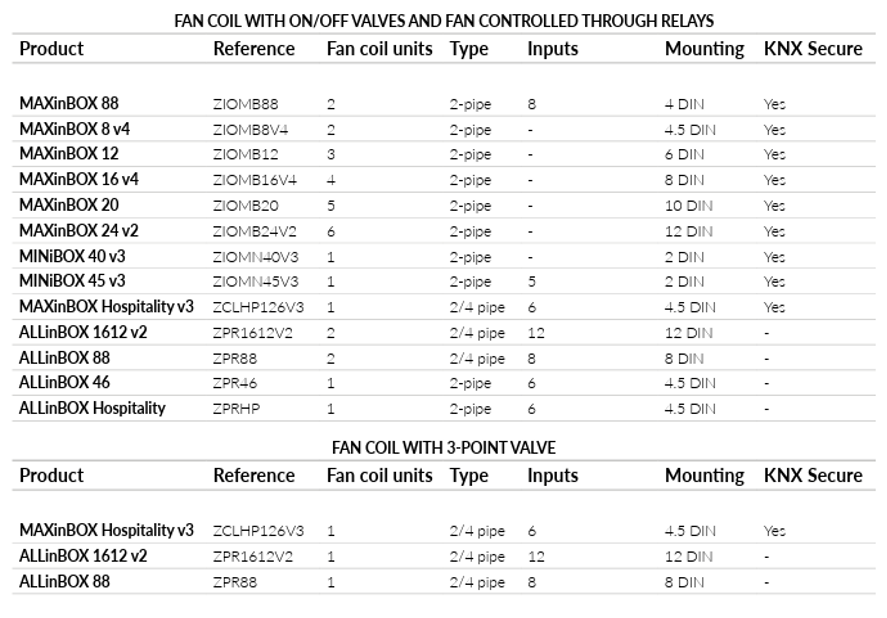
Depending on the number of pipes, thermostat control, type of valve and fan, the following options are available:
A. Valve and fan speed controlled through relays:
B. Valve controlled through 0-10V signal and fan speed activated with relays:
C. Valve controlled by relays and fan speed regulation through 0-10 V signal.
D. Valve or fan speed controlled with 0-10 V signals. Please note: In fan coil systems where one of the control signals is not 0–10 V, an additional actuator is required to control the non-0–10 V element.
Here is a brief summary:
The main difference between the two devices is that the DALI BOX Interface allows individual control of each ballast, which enables the creation and control of additional groups through KNX. In contrast, the DALI BOX Broadcast only allows commands to be sent in broadcast mode, it is not possible to control each ballast individually.
In addition, the DALI BOX Interface allows the lighting control of emergency ballasts (DT1) and color ballasts (DT8), while the DALI BOX Broadcast does not offer this functionality.
At the hardware level, the DALI BOX Interface incorporates a display that, together with the DCA, facilitates addressing a ballast when it is replaced, as well as commissioning and assigning ballasts to groups. It is also capable of individually reporting errors for each ballast, allowing simpler maintenance.
Feature | DALI BOX | InBOX DALI |
No. of ballasts | 64 | 16 |
Installation | DIN rail (4.5 modules) | Flush mounting |
Powered by | 230 V | KNX bus only |
No, our DALI BOX devices come with an internal power supply that powers the ballasts. In the case of the inBOX DALI, the ballasts are powered by the KNX bus, which explains the limitation of 16 ballasts.
Please note: Only one power supply unit is allowed on a single DALI line. Since our interfaces already include this power supply, it will not be possible to introduce any other element with a power supply in the installation (except for the inBOX DALI).
The following table explains the main differences between them:
Feature | BIN-T | QUAD v3 |
Input Types | Binary inputs* + input for temperature probe | Analog-digital inputs |
Outputs Type | LED outputs | Not applicable |
Thermostat | 1 | 4 |
KNX Secure | YES | YES |
* Can be configured as a pulse counter, even double.
QUAD v3, unlike the BIN-T, allows the connection of analogue inputs. These analogue inputs can be configured not only as temperature probes but also as motion sensor, which can be set up as customised NTC probes, introducing your own resistance/temperature parameters, or the “Zennio probes”.
The BIN-T device can configure its binary input as a pulse counter, including a double pulse counter. Additionally, it allows its channels to be configured as LED outputs.
According to KNX standard this possibility depends on each manufacturer. Our KUPSupply allows you to even connect them together (at a distance of 0 meters between them). Indeed, it is possible to connect in parallel. However, there are certain restrictions for this setup:
Yes, but it is not recommended. Power supplies of different sizes can cause imbalance. The smaller power supply can limit the larger one, which can lead to inefficient operation. For example, if you use a 640 mA power supply and a 320 mA power supply, and the total consumption is close to 960 mA, the current is split evenly. This can cause one power supply to work beyond its capacity and the other power supply to work below its capacity. It is best to use two supplies of the same size to avoid problems.
It is possible, although it is recommended to use a power supply of the same size as the ALLinBOX itself. It must be taken into account that ALLinBOX must always be powered at 230 V, since in case of being powered through the KNX BUS, its operation may not be correct, as well as that of the KNX power supply of the installation.
No, the ALLinBOX must always be powered with 230VAC. If it is powered through the KNX bus instead, its operation might not be correct, and it could also affect the performance of the KNX power supply in your installation.
It is true that there are no external buttons as in the rest of the actuators to act on relays. However, there is always the option of acting directly on the outputs with the IR remote control.
Zennio offers multiple lighting control options based on the type of load and circuit:
For controlling a LED strip with only On/Off functionality, the suitable device would be one of our multifunction actuators. These actuators are versatile and can handle various types of loads, including LED strips.
To control the On/Off and dimming of LED strips, you need to choose the right dimmer based on the type of LED strip and whether it operates on constant voltage or constant current.
For AC-operated LED we have the following options:
For a DC-operated LED, if operating at constant voltage, we have:
If operating at constant current:
For accurate selection, you can use our Lumento calulator to help determine the best device based on your LED strip’s requirements.
Load Disconnection:
Size:
Both devices allow their channels to be connected in parallel to increase the total power capacity. For more details, please refer to the device datasheet.
Yes, we have dimmable actuators with load disconnection relay. This is one of the main differences between our NarrowDIM and inBOX DIM devices, and the DIMinBOX devices, the first two maintain a residual current when the switch-off order is sent, as they do not have that internal relay that allows the load disconnection.
This means that, if the load connected to the NarrowDIM or inBOX DIM devices is very small, it can be subtly switched on as it is still powered, although this is unusual and occurs in very specific cases. However, the DIMinBOX devices ensure complete shutdown as they have a disconnection relay in each of their channels.
Other significant difference is the size, with Narrow DIM being more attractive as it is smaller, although with lower power to control. In any case, both NarrowDIM and DIMinBOX allow their channels to be connected in parallel to increase the power to be controlled. For more information, take a look at the datasheet of the device.
If the switch of the IndustrialBOX is manually operated, this information does not reach the KNX Bus, so the action is carried out, opening or closing the relay, but the status does not change on the KNX Bus. However, if we modify the order from ETS, in addition to being carried out, the status will be saved. That is, if I have turned off the switch (off state not saved) and now I send an off command through ETS, this action will not do anything in the relay, because it was already in that state but the off state will be saved (since it has been sent by ETS).
You can set up different sending modes: a periodic sending by selecting the desired time interval, a send when the value changes, or both a periodic sending and a send when the value changes.
Yes, you can configure alarms for both, excess (upper limit) and insufficient power (lower limit), is done through ETS parameters.
The IWAC Out Keypad works standalone, does not require any server and is KNX Secure. So in order to do the installation you will only need an electric lock and a relay that is compatible with your electric lock. The installation works this way:
Yes, it is possible. There are two ways to control the IWAC Out Keypad code:
Remote Code Management:
Allows to add, modify, or delete access codes remotely using KNX objects or parameters in ETS. This functionality is particularly useful for managing check-ins and check-outs in temporary rentals.
Through the own keypad:
Flexibility and Security:
The IWAC Out Keypad supports up to 99 individual codes, in addition to the master code. Codes can be enabled or disabled on a per-user basis, providing detailed access control and ensuring the highest security standards.
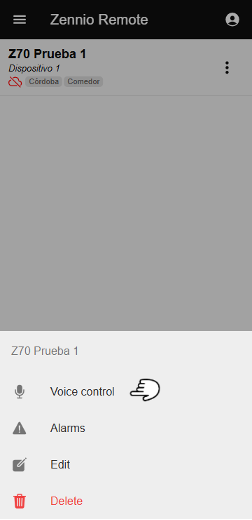
With the IWAC Out keypad, you can manage access codes that change after a certain time or request. When paired with devices like the Z50, Z70 v2, or Z100, you can remotely execute code refreshes using our Zennio Remote app.
Yes, with Z-Access, our card writing and Bluetooth ® key generating software. Z-Access allows room access reports for staff, knowing who has written new cards or cancelling existing keys so they are no longer valid. Z-Access communicates with all door readers, IWAC Display and IWAC Out, and it can work offline.
Yes, KNX Secure mode must then be disabled for the corresponding group addresses.
Yes, the Secure setup can be enabled or disabled in the ETS.
Yes, you can communicate between two KNX Secure devices using security even if the line couplers in the system are not KNX Secure enabled. However, it’s important to understand the implications of this setup.
If the line couplers are not KNX Secure, they will not be able to decrypt or understand the secured messages passing through them. However, they can still forward these encrypted messages across the lines they connect.
BCU protects each device while Project password protects all the project.
Yes.
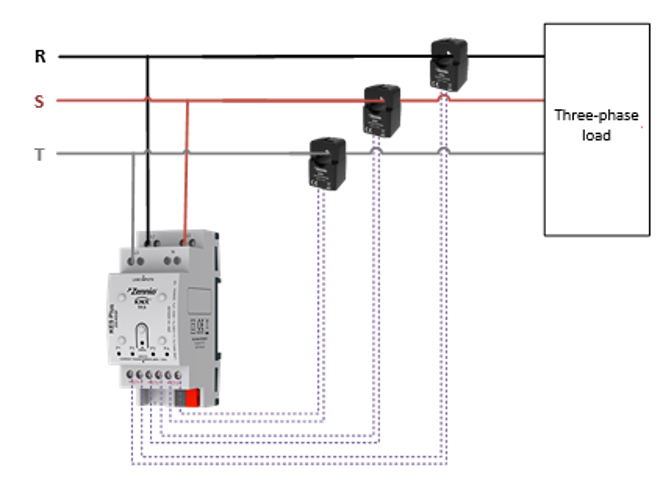
The maximum current that the KES Plus supports per channel is 260 A, the 600 A clamp meters are required to measure this current.
Yes, this combination is possible. You can find an installation diagram below.
While it is recommended to use S0 type B pulses for the KCI 4 S0, some instances have shown compatibility with other pulse types. However, this compatibility is not guaranteed, and we cannot ensure correct operation with non-S0 pulses.
If you have any questions regarding the compatibility of your pulse counter with our device, please feel free to email us at support@zennio.com.
It is always recommended to use KCI 4 S0, this device is designed to measure S0 class B pulses sent by potential free counters. This option is much more accurate than the KEM as the K and a parameters are defined for a specific flow, as this flow data is variable in a house, the values obtained during monitoring with KEM will not be accurate.
Yes, both connections can be made simultaneously, however, they cannot play at the same time.
One will have priority over the other, and this priority is configured via ETS. So, when starting playback on the source configured as priority, the audio of the secondary source will be stopped until the decoupling/disconnection of the first one is detected.
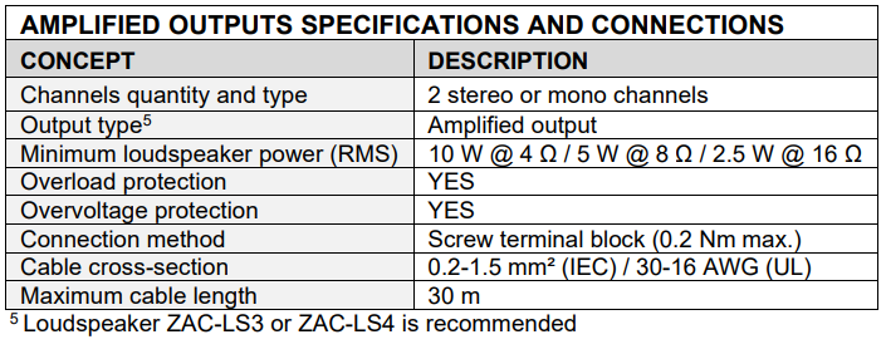
Yes, amplifiers can be connected, as long as they meet all the requirements as the minimum loudspeaker power.
The Z50 is part of our new family of touchscreens, featuring a new graphical environment, higher resolution, and a larger display that can be oriented both portrait and landscape. This updated interface includes customizable icons, different box sizes, and two themes (night/light) to adapt to various lighting conditions.
The Z50 also introduces exciting new functionalities such as voice control through voice assistants like Alexa and Google Home. Additionally, the Z50, along with the Z70 v2 and Z100, allows Video Intercom integration and can display up to 10 IP cameras on a navigable panel.
Our new touchscreen family boasts a more powerful and user-friendly energy monitor, along with technical features such as the Proximity and Luminosity Sensor. We encourage you to check the Manual to explore all these new functionalities in detail.
Unlike the Z41 series, where each model had specific hardware and limited functionalities based on the type of screen you purchased, the new generation allows you to activate additional features through licenses whenever you need them.
The Z50 offers significant advantages and superior performance. Overall, the Z50 provides a more versatile and powerful solution for your needs.
Summary
Feature | Z41 | Z50 |
Display | Smaller display with lower resolution | Larger display with higher resolution and new graphical environment |
Interface | Standard interface | Customizable icons, different box sizes, and two themes (night/light) |
Voice Control via Alexa and Google | Not available | Available by acquiring the ZenVoice (8500008 ) and Smartphone Control Licenses |
Video Intercom Integration | Available only in Z41 COM | Available by acquiring the Video Intercom License (8500007) |
Remote Control | Available only in Z41 COM and Z41 Pro | Available by acquiring the Remote Control License (8500006) |
IP Camera Support | Not available | Display up to 10 IP cameras on a navigable panel |
Energy Monitor | Less advanced | More powerful and user-friendly energy monitor |
Internal Temperature Probe | Available | Available in Z50 |
Analog-Digital Inputs | 2 inputs only available in Z41 Pro and Z41 Lite | 2 inputs |
Yes, you will have to change the metallic plate to which the Z41 is anchored for the Z50 that is included, but the hole and the mechanism box will be the same.
The following table explains the main differences between them:
Feature | Z50 | Z70 v2 | Z100 |
Display Size | 5” | 7” | 10” |
Number of Controls | Up to 96 | Up to 144 | Up to 180 |
Inbuilt Temperature Probe | Yes | Yes | No |
Analog-Digital Inputs | 2 | 4 | 4 |
Orientation | Portrait / Landscape | Landscape | Landscape |
No, the Z50/Z70v2/Z100 are connected to the internet via ethernet cable.
Yes, as the touchscreen communicates directly with the server.
No, you do not need a licence to view an IP camera from a Z50/Z70v2/Z100 touchscreen. You simply need to configure the IP settings of your display and IP camera following the instructions provided in section 2.1.15 of the User Manual.
Yes, internal calls functionality requires a license installation (Video Intercom License). If not, even being possible to configure it from ETS, its use will not be accessible.
Yes, from Zennio Remote it is possible to view the integrated IP cameras on the touchscreen.
Here’s what you need:
Once you have these, you can easily access your IP cameras from your smartphone with Zennio Remote.
Unfortunately, no. Each version of the Z41 was designed with specific hardware to include or exclude certain functionalities. The Z41 COM supports video intercom and remote control, the Z41 Pro supports just remote control, and the Z41 Lite supports neither. Indeed, ZenVoice was developed after the Z41 series was released, so it is not compatible with those models.
With our new generation of touchscreens—Z50, Z70 v2, and Z100—we’ve changed our approach. Now, all functionalities are available in each device and can be activated by purchasing specific licenses. This means you can add new features to your touchscreen later on by acquiring additional licenses.
To avoid having to redo the programming from scratch, you can use the free ETS APP “Zennio Parameter Copier”, which helps in the versions update process of Zennio products. You only have to select the same device with the two versions, and the copy is made. After copying, pop-up windows will appear to indicate any differences between the versions, which should be reviewed in case they have not been copied correctly.
Link to app and manual:
https://www.zennio.com/es/documents/zennio_parameter_copier_
https://zennio.com/download/manual_Parameter_copier_es
Please note that from version 3.7 onwards in Z50/Z70 v2/Z100, it is not necessary to update the application program and the firmware, as the versions are compatible.
Material:
Customization:
Both series can be customized through Touch My Design tool.
The real advantage of using shutter-specific actuators is that the relays connected to the shutter motor wires are specially designed for this purpose. In addition, they are also a great advantage on an economic level.
In the case of the ShutterBOX Drive, it also performs automatic travel time measurement by means of current detection and incorporates a solar tracking module.
The automatic measurement performed by our ShutterBOX Drive takes into account the electric current consumed by the shutter motor during its operation, detecting the upper and lower limits of the shutter by the current increase and, having calculated the movement between limits, the actuator knows the up and down times.
There are two types of soft pushbuttons: non-KNX and KNX. The non-KNX are designed to be connected to the binary inputs, so for the installation, any KNX device with binary inputs is required
On the other hand, KNX pushbuttons do not require any additional device for installation, they simply need to be connected directly to the KNX bus.
Yes, we can guarantee that the combination works correctly, as we have performed numerous tests.
There is no difference, the RemoteBOX is designed as an alternative to touchscreens, offering the same control capabilities. The only differences is the hardware: while touchscreens allow you to control the installation directly, the RemoteBOX allows exclusively remote control through the app or web server, supports up to 100 controls, expandable up to 180 with a license.
Both devices operate independently, allowing you to configure different controls on each. For instance, you can use a Z50, Z70 v2, or Z100 for primary local control, and complement it with a RemoteBOX configured with all controls for full remote management.
Having both devices in the same installation is possible, though not required.
No, it is not necessary. The RemoteBOX comes with the remote control license included.
The additional licenses available are either to expand the number of controls from 100 upto a maximum of 180, or to enable voice control through the ZenVoice license.
No, that is not possible. The RemoteBOX has a maximum limit of 180 controls, so you cannot purchase multiple licenses for the same device to increase the number of controls. The extension license is not cumulative.
No, the RemoteBOX is designed to have the remote control of the installation. It does not have KNX-IP interface functionality, so it cannot be used to download programming.
No, internet access is required in order to control the installation, as the system operates through a cloud-based service.
No, this is not possible. However, voice control is available with the ZenVoice license.
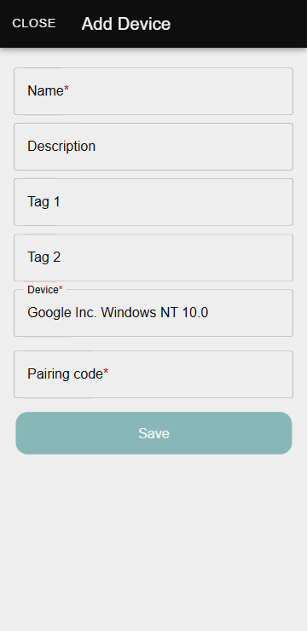
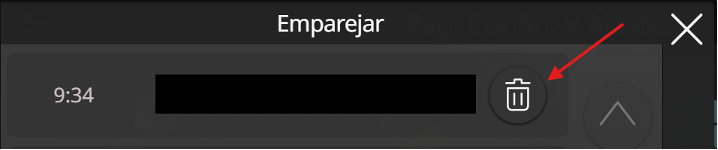
The initial pairing has to be done through WebServer Tool. Go to the “Remote Control” section and click on “New Pairing” to generate a QR code.
You will need two RF coupler, one for each line. Below you can find a scheme of installation:
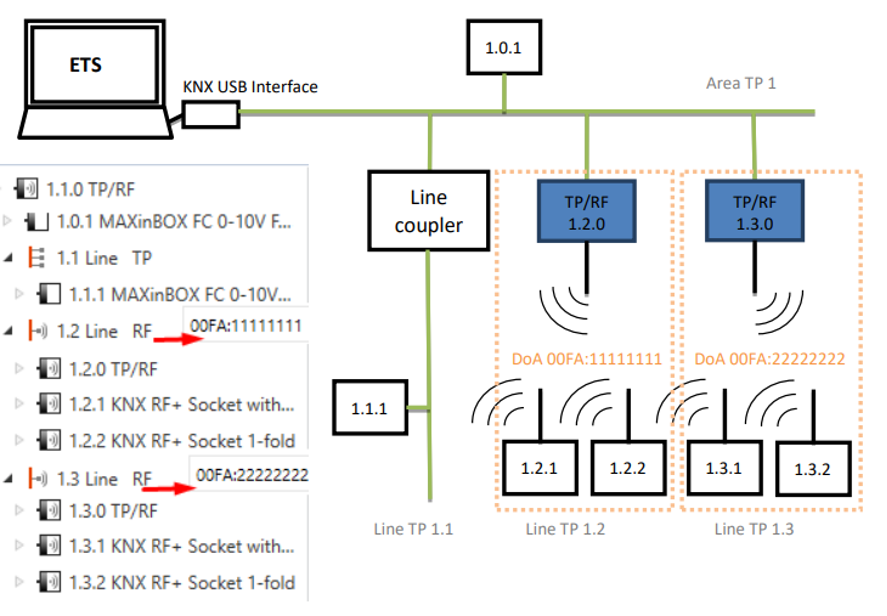
In the configuration, to make use of the RF coupler, you will have to create a new RF line to include the RF coupler and the RF devices to be controlled, it is not possible to mix TP and Rf devices in the same segment. For example, in the previous image, the area has three lines where:
Presentia Wx v2 is a motion detector for in-wall flush mounting and is specially designed for hallways as it detects transverse movement. There is no maximum height, but since it only detects transverse movements, it should be installed at a height where detection is posible. Our recommendation is to install from close to the ground (detecting feet) up to about 1 m.
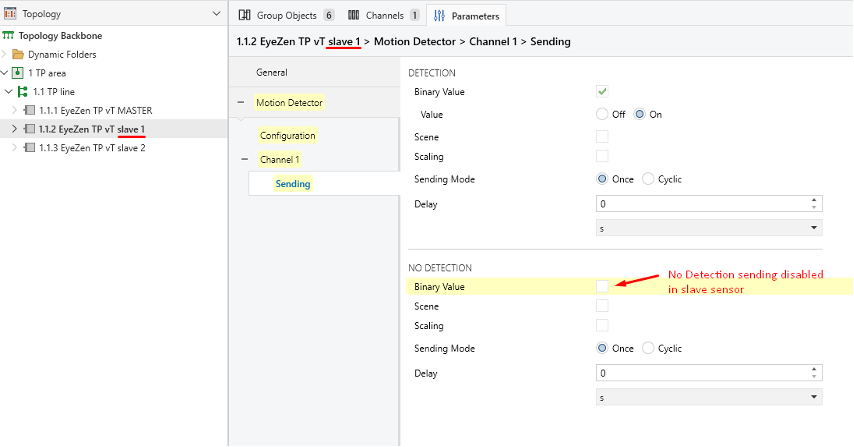
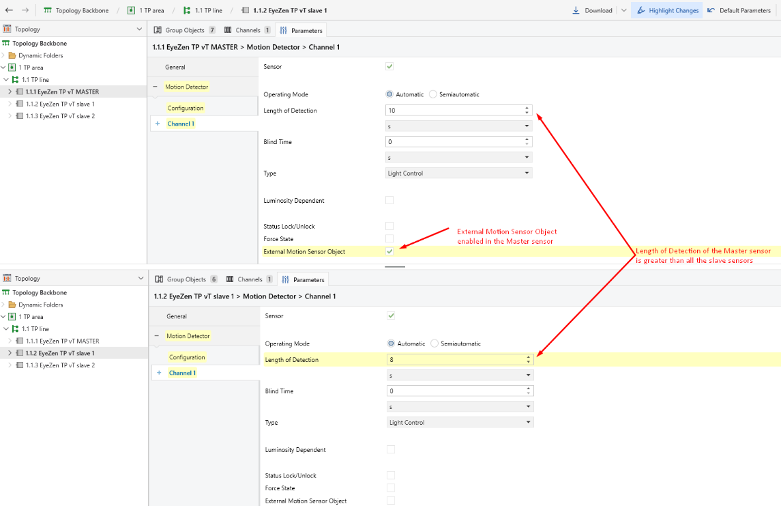
You will need to establish one of your sensors as the master detector and the other one as slave
Then, you need to link the detection output (value 1) objects of all slaves with the External Motion Detection of the sensor you selected as the master.
Also, the Length of Detection time you configure in the master sensor must be greater than the detection lengths of all the slave detectors.
In this way, only the master sensor will transmit the detection and no detection state to the actuators and any other slave sensors will just transmit the detection binary value 1 to the master sensor.
At www.zennio.com cookies are used, its own and third-party cookies, for personalization to improve the quality of the product or service offered; analytics to measure the audience and analyze the users' behaviour; and behavioural advertising to offer personalized advertising based on the users' browsing patterns (for example, pages visited). You could find more information in our Cookies Policy. You can accept all the cookies by clicking on the "Accept Cookies" button or reject them by clicking on the "Reject Cookies" button. You can also manage these cookies and, therefore, accept or reject them individually or entirely from the Settings Panel.